




A single guest noise complaint costs more than the price difference between two fridge technologies. One refunded night wipes out the saving. Yet the hotel minibar fridge is still often the last spec checked in a room fit-out, chosen on capacity alone. It shouldn’t be: the cooling system decides how quiet, how power-hungry and how compliant your in-room refrigeration will be. This minibar fridge buying guide compares absorption, thermoelectric (including fan-free heat-pipe designs) and compressor units using published datasheets, then hands you selection and procurement checklists.
There is no single winner: the right mini bar fridge depends on placement and climate. Within two metres of the bed or in sleep-sensitive rooms, choose absorption or a fan-free heat-pipe unit. In air-conditioned rooms, thermoelectric delivers the lowest daily consumption — from 0.3 kWh/24h at 48 L. For hot climates, fast pull-down or larger capacity, choose a compressor model.
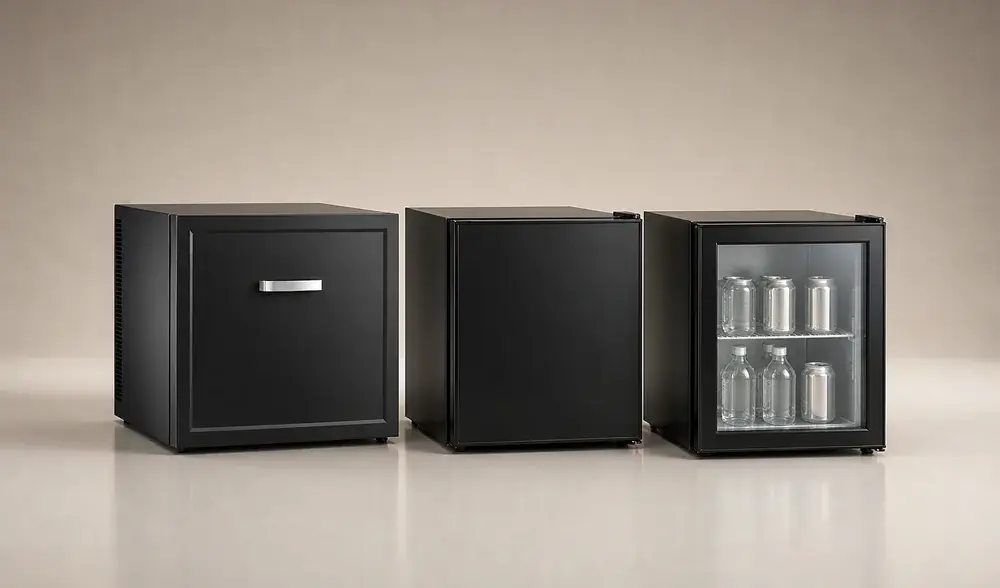
hotel minibar fridge cooling systems compared
Why cooling technology is the first spec to check
Guests forgive a minibar that chills slowly. They do not forgive one that clicks on at three in the morning. Craven Cooling, a UK refrigeration specialist, measured background noise in a typical guest bedroom at roughly 25–30 dB(A); compressor minibars in the same rooms hit 35–42 dB(A) every time the unit cycles (Craven Cooling, 2026). That gap is why “silent mini fridge for hotel rooms” is the most common entry point into the category, and why the word “silent” on a listing proves nothing: a fan-cooled thermoelectric model is not a fan-free heat-pipe design. Verify the acoustic spec per model, not per technology.
How each technology works, and where each one wins
Absorption: silence as a design principle
Absorption minibars run an ammonia–water cycle driven by heat. No compressor, no fan, nothing in the cabinet that can make sound. The market agrees: absorption held a 56.0% technology share of the minibar refrigerator market in 2024 (Grand View Research, reported May 2025), and premium properties keep specifying it where sleep quality is part of the product.
The trade-offs are thermal and financial. Pull-down is slower, and cooling output drops in hot or poorly ventilated cabinets — Craven Cooling puts the practical limit at roughly 32 °C ambient for a 40 L cabinet. Silence has a running cost too: 0.8–1.0 kWh/day for absorption against 0.25–0.35 kWh/day for a same-size compressor. What absorption handles well is awkward power: the platform runs from 12V DC, which matters for lodges and weak-grid sites. A representative spec: the 28L 12V absorption mini fridge draws 60W, holds 0–8 °C, and carries climate class N.
Thermoelectric and heat-pipe: lowest daily consumption
Thermoelectric cooling uses a solid-state Peltier module: no refrigerant, no compressor, minimal vibration. Most fan-cooled units are quiet rather than silent, because the small fan is audible in a 25 dB(A) room. The premium subset is the fan-free heat-pipe design, which moves heat passively with no moving parts. The 45L heat-pipe hotel minibar fridge with pull-out drawers is rated 100% silent at 65W input and 0.6 kWh/24h.
Energy is the reason to buy this category. The 48L thermoelectric hotel mini fridge draws 0.3 kWh/24h at 83W — the lowest daily figure on any datasheet here — with ETL, CE, CB, SAA, ROHS and CCC listings. Where it struggles is heat: performance falls as room temperature climbs, so these units belong in air-conditioned rooms, not in a closed cabinet beside a west-facing window.
Compressor: strongest cooling, at the cost of noise
A compressor mini bar fridge for hotels runs the same vapor-compression cycle as full-size refrigeration, scaled down. It pulls down fastest, recovers quickest after restocking, and it is the only category certified across climate classes N, ST and T. The 48L compressor mini refrigerator runs at 75W, energy class E, manual defrost, mechanical thermostat, listed to CE, ETL, SAA, MEPS and PSE.
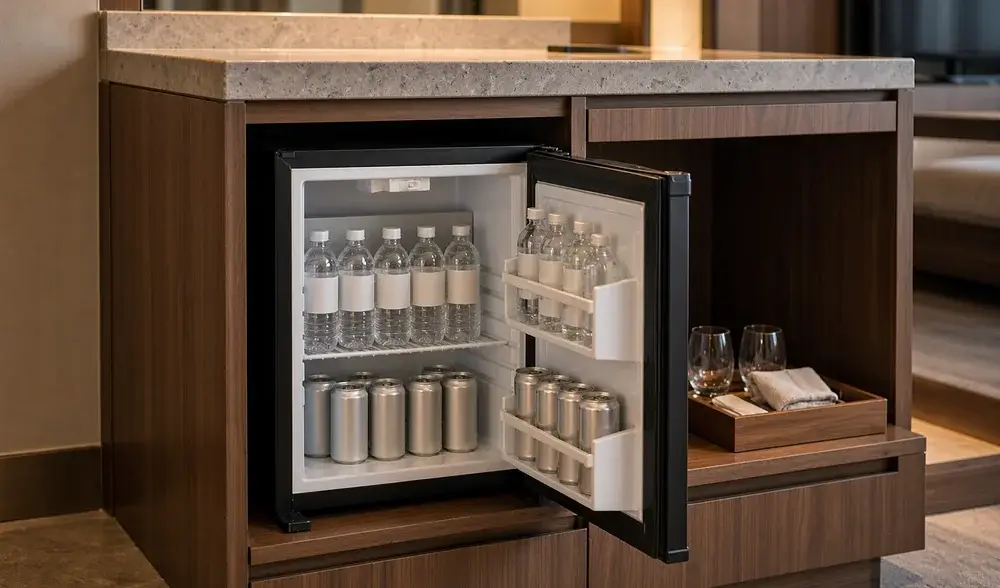
hotel minibar fridge in suite cabinet
You pay for that in decibels: 35–42 dB(A) with start-stop cycling (Craven Cooling, 2026), plus refrigerant compliance duties on R134a or R600a.
What the minibar refrigerator market numbers say
Fortune Business Insights (2026) values the market at USD 374.46 million in 2025, growing 3.25% a year to 2034, with Europe at 30.9% of demand, North America 27.5% and Asia-Pacific 25.4%. Grand View Research (reported May 2025) projects USD 432.4 million by 2030 at 3.2% and flags thermoelectric as the fastest-growing segment, even though absorption led with 56.0% in 2024. Silent cooling is the installed base; low-power thermoelectric is where growth is heading.
Absorption vs thermoelectric vs compressor: side by side
The sharpest trade-off in a minibar buying decision is absorption vs thermoelectric, but compressor changes the math in hot climates.
| Criterion | Absorption | Thermoelectric / heat-pipe | Compressor |
|---|---|---|---|
| How it cools | Ammonia–water cycle driven by heat; no moving parts | Solid-state Peltier module; heat-pipe variants fully passive | Refrigerant vapor-compression cycle |
| Noise | Silent | Silent (fan-free heat-pipe) to low hum (fan models) | Cycling hum; 35–42 dB(A) typical (Craven Cooling, 2026) |
| Cooling ability | Slower pull-down; drops above roughly 32 °C ambient | Modest pull-down; best in cool, air-conditioned rooms | Strongest; fast recovery; N/ST/T climate classes |
| Energy use | Highest running cost of the three; 0.8–1.0 kWh/day at 40 L | Lowest daily draw in AC rooms; 0.3–0.6 kWh/24h on the models here | 0.25–0.35 kWh/day at 40 L (Craven Cooling, 2026) |
| Maintenance | No moving parts; little routine servicing | No moving parts; fan or Peltier module is the main wear item | Thermostat, door seal and compressor are the wear items |
| Best fit | Premium rooms, units near the bed, enclosed joinery | AC’d rooms where daily kWh is the metric | Serviced apartments, hot climates, larger capacity |
| Main drawback | Slow pull-down; heat sensitivity; running cost | Limited pull-down in hot rooms | Noise; refrigerant compliance paperwork |
The datasheets behind those conclusions, all Smeta models:
| Model | Type | Capacity | Input power | Daily consumption | Refrigerant | Climate class | Voltage | Certifications | 40HQ load |
|---|---|---|---|---|---|---|---|---|---|
| TSL-45EB7(B) | Heat-pipe / thermoelectric, drawer | 45 L | 65 W | 0.6 kWh/24h | None (refrigerant-free) | — | 220–240 V/50 Hz or 110–127 V/60 Hz | CE, CB | 440 units |
| TSL-48EB7(C) | Thermoelectric | 48 L (1.7 cu.ft) | 83 W | 0.3 kWh/24h | None (refrigerant-free) | — | 220–240 V/50 Hz or 110–120 V/60 Hz | CE, CB, ETL, SAA, ROHS, CCC | 548 units |
| TSX-28BT | Absorption | 28 L | 60 W | — | R717 (ammonia) | N | 12 V; 110 V/60 Hz; 220–240 V/50 Hz | — | 540 (40GP) / 675 (40HQ) |
| TSX-30B2E(T) | Absorption, glass door | 28 L gross | 60 W | — | NH3 | — | AC 0.3 A / DC 5.5 A | CE, CB, SAA | — |
| TSX-50B2E(T) | Absorption, glass door | 44 L gross | 90 W | — | NH3 | — | AC 0.4 A / DC 7.5 A | CE, CB, SAA | — |
| TSF-48D6 | Compressor, single door | 48 L | 75 W | energy class E | R134a / R600a | N/ST/T | — | CE, ETL, SAA, MEPS, PSE | 580 units |
Blank cells mean the value is not published on the current datasheet. Treat unlisted specs as unknown, never as estimated.
Which type fits which property
Where the fridge sits matters more than which brand it carries:
- Luxury, boutique and suites (fridge within 2 m of the bed): absorption, or a fan-free heat-pipe drawer unit in 28–45 L. In enclosed joinery, settle ventilation clearance with the furniture contractor first.
- Midscale and economy chains (cabinet nook, air-conditioned rooms): thermoelectric wins on running cost. A 48L unit at 0.3 kWh/24h across hundreds of rooms is a real utilities line item, and 548 units fit one 40HQ.
- Serviced apartments, extended stay and hot climates: compressor, with N/ST/T coverage and certification (MEPS, PSE, SAA) for markets running their own efficiency schemes.
- Off-grid and weak-grid sites (safari lodges, parts of the Middle East, Africa and Latin America): 12V DC absorption tolerates unstable supply and stays silent.
- Merchandising and visible display: glass-door absorption in 28 L or 44 L gross keeps the display silent while the product stays visible.
Then settle four things: room temperature without air-conditioning, distance from the bed, service response time, and whether your market needs certifications the supplier already holds.
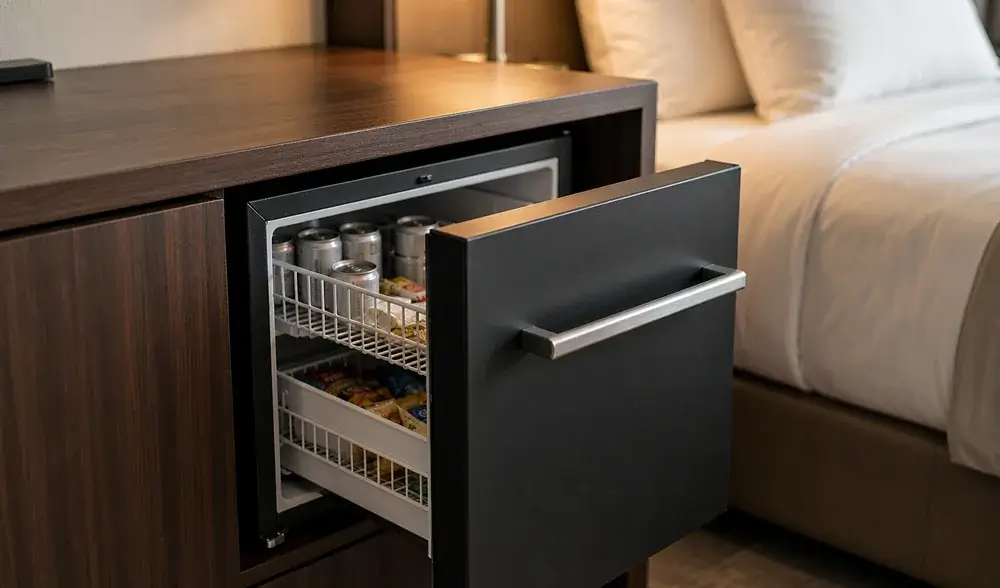
hotel room minibar fridge drawer detail
Voltage, climate class and refrigerant compliance by market
EU and UK. Regulation (EU) 2024/573 has applied since 11 March 2024, replacing the previous F-gas framework (No 517/2014). It sets GWP-based placement bans and steps HFC quotas down toward a full phase-out by 2050. Ammonia (R717) absorption carries no HFC exposure, and R600a compressor designs sit well inside the limits. CE and CB reports are the baseline paperwork.
US and Canada. ETL listing is the practical requirement, and the EPA’s SNAP program lists hydrocarbon refrigerants including R600a as acceptable in small refrigeration, subject to charge limits. Ask for the refrigerant declaration and check it against the applicable limit.
Australia and Japan. SAA plus MEPS for Australia, PSE for Japan. The 48L compressor above carries both alongside CE and ETL.
Americas and other 110V markets. Lock the 110–120V/60Hz variant per model; the thermoelectric 48L and the 45L heat-pipe drawer both ship in 110V versions. Thermoelectric units hold no refrigerant at all, so F-gas paperwork disappears.
Bulk procurement and certification checklist
Run this with the supplier before you sign:
- Confirm cooling type against room placement and real ambient temperature. Sample one unit in a guest room, not a showroom.
- Demand input power, kWh/24h, temperature range, climate class and dB(A) where published. If a value is not published, it is not a spec; refuse estimates.
- Match certifications to the destination market — CE/CB, ETL, SAA, MEPS, PSE, ROHS, CCC.
- Fix voltage and frequency variants per market in the contract, including 12V DC.
- Collect refrigerant documents: F-gas declarations for the EU, SNAP references for the US.
- Model container economics: 440 units per 40HQ for the 45L heat-pipe drawer, 548 for the 48L thermoelectric, 675 for the 28L absorption, 580 for the 48L compressor.
- Agree warranty terms and spare parts — thermostats, Peltier modules, door seals, shelves — with named lead times.
- Price total cost of ownership, not unit price. Our breakdown of how refrigerator manufacturing costs break down separates sustainable quotes from the ones that fail on quality.
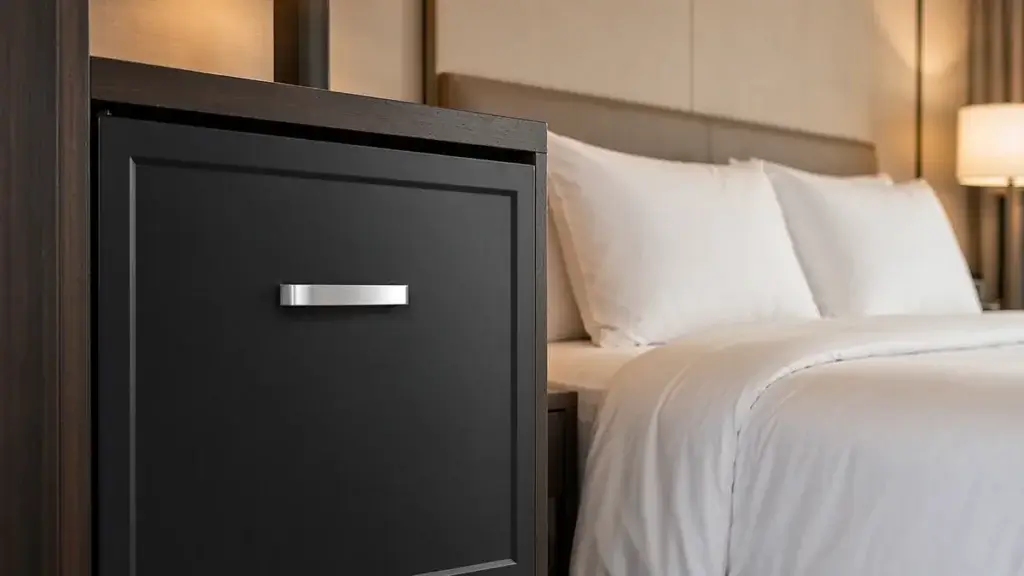
hotel minibar fridge buying guide
Frequently asked questions
Which minibar cooling type is the quietest?
Absorption: no compressor, no fan, no moving parts. A fan-free heat-pipe thermoelectric unit is the closest equivalent. Fan-cooled thermoelectric models are quiet but not silent; compressor minibars are the loudest of the three.
Are thermoelectric minibar fridges energy efficient?
In air-conditioned rooms, yes — 0.3 kWh/24h for a 48L thermoelectric model and 0.6 kWh/24h for a 45L fan-free heat-pipe drawer unit. Efficiency falls as ambient temperature rises, which is why hotel mini fridge energy consumption depends more on placement than on the technology label.
Can a compressor mini bar fridge be used in a hotel bedroom?
It can, and it is the right call in hot climates and serviced apartments. In a quiet room, cycling sits at 35–42 dB(A) against a 25–30 dB(A) background (Craven Cooling, 2026), which light sleepers notice. If you must, keep it away from the headboard and inside closed cabinetry.
When should a hotel choose a glass-door minibar?
When the minibar is meant to sell, not just store. A glass door turns the cabinet into a display for suites, lounges and properties that merchandise in-room drinks. The trade-off is insulation: pair it with absorption cooling and keep the cabinet ventilated.
What size minibar do hotels typically use?
28–50 litres covers most in-room use. Drawer formats around 45 L fit under counters; glass-door units in 28–44 L gross suit visible display; serviced apartments often step up to 48 L compressor units.
The bottom line
The decision compresses into three lines. If the fridge sits within two metres of the bed, buy absorption or a fan-free heat-pipe unit and protect your sleep-quality reviews. If rooms are air-conditioned and daily kWh is your metric, thermoelectric delivers the lowest consumption in the category. If heat, humidity and fast recovery define the property, a compressor with N/ST/T coverage is the honest answer.
Absorption still holds 56.0% of a market heading toward USD 432.4 million by 2030, while thermoelectric is its fastest-growing segment (Grand View Research, 2025). Whichever way your property leans, let the datasheet, not the brochure, make your minibar fridge decision.
Start with the 45L heat-pipe hotel minibar fridge with pull-out drawers to see what a fully silent, datasheet-complete unit looks like, then contact our team for volume quotes, voltage variants and shipping configurations.
References
- Grand View Research, Minibar Refrigerators Market Report (data reported via GII, May 2025). grandviewresearch.com
- Fortune Business Insights, Minibar Refrigerators Market (2026). fortunebusinessinsights.com
- EUR-Lex, Regulation (EU) 2024/573 on fluorinated greenhouse gases (in force 11 March 2024). eur-lex.europa.eu
- US EPA, Significant New Alternatives Policy (SNAP) Program. epa.gov/snap
- Craven Cooling, Minibar Fridges & Quiet Refrigeration for Guest Bedrooms (2026). cravencooling.co.uk
- Smeta product datasheets: TSL-45EB7(B), TSL-48EB7(C), TSX-28BT, TSX-30B2E(T), TSX-50B2E(T), TSF-48D6. smetagroup.com


