




If you sell refrigeration into the US, UK, Canadian or Australian market, chances are the “4 door fridge” searches in your own analytics are not a fad. Between 2025 and 2026, this query cluster grew from roughly 1,600 to more than 5,000 impressions on our own site data alone — mirroring a wider shift toward multi-door refrigerator formats on every major retail site.
But “4-door” is not one product. Factories quote four genuinely different architectures under the same label, and picking the wrong one for your market is the most expensive mistake a distributor can make with this category. This guide breaks down the configurations, the capacity math, the spec-sheet items that separate a sellable SKU from a return risk, and the landed-cost framework you should run before placing a container order.
Why 4-Door Fridges Are Outgrowing the Fridge Market
The household refrigerator market overall is a steady-growth category: Statista estimates global revenue at US$126.5 billion in 2025, rising at a 4.48% CAGR through 2030. Global Market Insights puts the 2026 figure at US$62.1 billion on a narrower product scope, with 5.2% annual growth to 2035 — and explicitly identifies larger multi-door configurations as the main driver pushing revenue growth above shipment growth in mature markets.
The multi-door segment itself is where the premium sits. QYResearch figures show global multi-door refrigerator production at roughly 28.4 million units in 2025 at an average selling price of about US$750 per unit, with industry gross margins between 20% and 35% — well above entry-level top-mount product. One market research estimate (Future Market Report) puts four-door models at around 42.7% of multi-door segment revenue, making the 4-door format the single largest slice of the premium fridge business.
For an importer or retail chain, the practical takeaway: a 4-door fridge is no longer a niche showpiece. It is the volume anchor of the premium tier, and your supplier’s ability to deliver it consistently at the right energy class now decides your margin.
The Four Configurations You Will Actually Be Quoted
“4 door fridge” covers four distinct door architectures. Distributors should quote by architecture, not by door count:
- 4-door French door — two half-width fridge doors on top, two pull-down fridge or freezer doors below. The best-selling premium layout in Western markets; the bottom pair is usually split fresh/freeze zones. See a working example in the 4-door French door fridge range.
- Cross-door / quad-door — four equal vertical doors stacked two-by-two. Popular in Asia-Pacific and increasingly quoted for compact Western kitchens where a full-width door swing won’t fit.
- Side-by-side + drawer — vertical split with freezer drawers below. Trades fresh-food width for freezer organization.
- American-style 4-door with triple-zone control — adds an independent convertible middle zone (chiller/wine/zero-degree) between fridge and freezer. This is the highest-ASP variant; the 611L triple-zone 4-door American fridge freezer illustrates the format.

The 4-door French door format — the volume anchor of the premium fridge tier in 2026.
Capacity Math: Litres, Cubic Feet and What Fits Your Market
Listings in the US and Canada use cubic feet; the UK, EU and Australia use litres. Convert fluently or your catalogue will confuse buyers: 1 cu ft = 28.3 litres. A 560L 4-door fridge is a 19.8 cu ft unit; a 611L unit is 21.6 cu ft.
Map capacity to the market segment, not to a “bigger is better” reflex:
| Segment | Capacity | Typical format |
|---|---|---|
| Apartment / metro AU & UK | 420–480L (15–17 cu ft) | Slim 4-door or cross-door |
| Suburban family (US/CA/AU) | 500–560L (18–20 cu ft) | 4-door French door |
| Large household / entertainer | 590–620L (21–22 cu ft) | Triple-zone American 4-door |
One overlooked spec here is depth. Counter-depth (about 60–68 cm excluding handles) versions command higher margins and lower return rates in North America because they align with standard cabinetry — but they cost the factory more in insulation and layout engineering. Confirm which depth your retail channel actually merchandises before defaulting to the cheapest quote. The large American style fridge freezer range shows how capacity and depth vary across one supplier’s 4-door lineup.
Spec Sheet Checklist: What Separates a Sellable SKU from a Return Risk
Before comparing factory prices line by line, audit these seven items. This is the list that decides warranty cost, not the brochure photo:
- Compressor type. Fixed-speed units are cheaper upfront; inverter compressors cut energy consumption materially and reduce noise complaints. If energy labels matter in your market, insist on inverter — for example, the 542L 4-door inverter refrigerator format.
- Cooling system. Total-no-frost (fan-assisted) versus partial direct-cool. Frost buildup is the number-one driver of appliance-store service calls.
- Refrigerant. R600a (isobutane) is the household standard globally; it is flammable, which affects shipping documentation and after-sales handling. Confirm the supplier provides the safety documentation.
- Climate class. SN/N/ST/T rating. Selling a subtropical-class requirement market (much of Australia) with a temperate-class unit compresses cooling performance at 38°C+ ambient — a quiet failure mode that shows up as complaints, not returns.
- Metal-cooling panel vs. plastic liner. Metal back panels in fresh-food zones hold temperature better after door openings — a real selling point for households with heavy use.
- Hinges and door swing. French-door configurations need self-closing hinges rated for high cycles. Cheap hinges are the most common early-life failure on 4-door units.
- Noise level. Under 40 dB is the retail benchmark for open-plan homes; anything above 44 dB will generate reviews you don’t want.
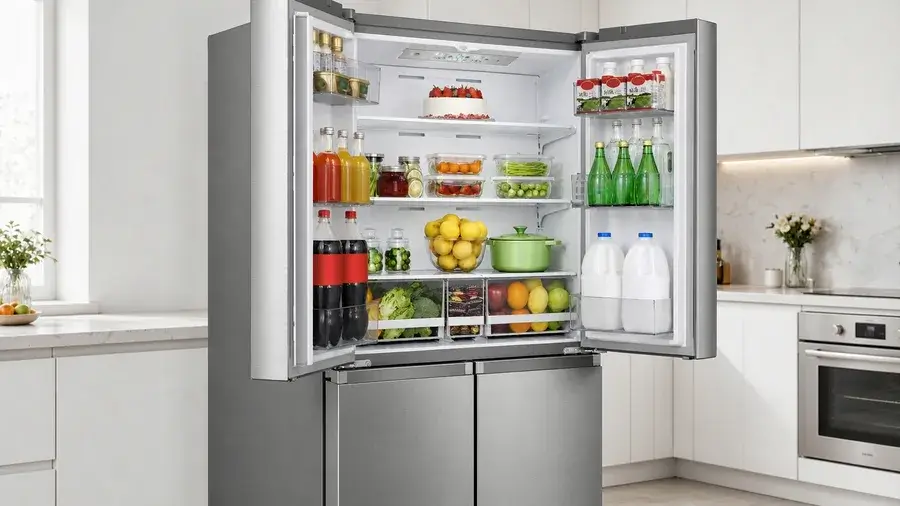
Interior zoning — fresh, convertible and freezer compartments — is what buyers actually pay for.
Ice Makers: Plumbed, Non-Plumbed or None
The ice-maker decision is a market decision, not a feature decision:
- Plumbed (water-line connected): standard expectation in North America, but adds installation friction and leak-liability in markets where tradespeople visits are expensive.
- Non-plumbed (tank-fed) dispenser: no installation requirement — a strong fit for UK/AU rentals and retrofit segments. The 560L 4-door French door fridge with ice maker shows this configuration.
- No dispenser: maximizes freezer capacity and minimizes service cost; still viable in markets where consumers use separate ice trays, but increasingly hard to merchandise at premium price points.
Rule of thumb: match the dispenser type to local housing stock. Plumbed sales in markets with low home-ownership (or where plumbed fridges void rental agreements) convert poorly.

Non-plumbed dispensers convert better in rental-heavy UK and Australian markets.
Certification Checklist by Market
Energy regulation is the part of the 4-door fridge business that quietly kills container orders at customs. Verify before shipping, not after:
| Market | What must be in place |
|---|---|
| US | DOE compliance under 10 CFR Part 430 (Appendix A1 test procedure); ENERGY STAR optional but expected by big-box retail |
| Canada | NRCan registration and EnerGuide label |
| EU | A–G rescaled energy label per Regulation (EU) 2019/2016 + EPREL database registration before placing on market |
| UK | UK energy label (separate from EU post-Brexit) |
| Australia / NZ | GEMS registration under AS/NZS 4474:2018; mandatory Energy Rating Label at point of sale; products must also pass pull-down, storage and defrost performance tests |
| GCC | SASO / G-Mark requirements depending on member state |
Ask each candidate factory for the actual test reports per model — not a certification logo on a brochure. A supplier that runs its own in-house lab will hand over reports within a day; one that borrows certificates will stall, and that stall predicts your customs experience.
Landed Cost: Run This Model Before You Negotiate Price
The factory price on a 4-door fridge is typically 30–40% below what the unit actually costs you on the shelf. Build a spreadsheet with these lines:
- EXW or FOB unit price (get both; the difference reveals the factory’s true export overhead)
- Sea freight — 4-door units are bulky by volume, not by weight; you pay per CBM. One 40ft HQ container is your realistic minimum order unit for mixed-SKU loads
- Duty + tariff — HS 8418.10/8418.40 classification per destination; US buyers should check current Section 301 status on Chinese-made units before finalizing margin
- Insurance, port charges, inland haulage
- Certification amortization — spread test-report and registration costs across expected unit volume
- Warranty reserve — for 4-door formats, budget 1.5–2% of FOB value; hinge and drawer-slide claims are the main line
For context on what a reasonable factory price actually contains, see our breakdown of refrigerator manufacturing costs and how to select a manufacturer. Given the segment’s 20–35% gross margin range, a quote far below your landed-cost model’s floor usually signals thinning insulation or a downgraded compressor — savings you repay in warranty.

Volume density makes container-mix planning decisive for 4-door SKU profitability.
Five Questions to Ask Before Placing the Order
- What is the inverter compressor brand and warranty term, and can we audit the supplier?
- Which energy test standard was each model certified under — and is the report per-model or a family claim?
- What is the drop-test and vibration protocol for export packaging, and has the packaging spec been validated on a full sea-freight route?
- What is the production lead time for 4-door French door configurations in peak season (September–November)?
- Can the factory support OEM branding, packaging customization and container-mix optimization across your SKU list?
A manufacturer running multiple production bases — for instance in both China and Thailand — can also hedge your tariff and logistics exposure across two origin points, which matters more for 4-door SKUs than for any other fridge category because of their volume density.
The Bottom Line
The 4-door fridge cluster is where premium refrigeration demand is concentrating in 2026: production of multi-door units reached roughly 28 million units globally at a ~US$750 average price, four-door architectures claim the largest share of that segment, and energy-label regimes on three continents keep tightening the entry bar. Importers who lock in the right configuration mix, verify per-model certifications, and model landed cost honestly will hold margin while competitors discover it at the service counter.
If you are building a 4-door fridge lineup for 2026 orders, contact our export team for the current model list, energy-class documentation and OEM terms.
Frequently Asked Questions
Is a 4-door fridge worth importing compared to standard top-mount models?
Yes, if your channel sells the premium tier. Multi-door units carry roughly 20–35% industry gross margins versus materially lower margins on entry-level formats, and 4-door models represent the largest share of that multi-door revenue — but only if the energy class and certifications match your market’s requirements.
How many cubic feet is a 560-litre 4-door fridge?
560 litres equals about 19.8 cubic feet (1 cu ft = 28.3 litres), which positions it for the suburban family segment in US and Canadian markets.
What certifications does a 4-door fridge need for Australia?
GEMS registration under AS/NZS 4474:2018, compliance with MEPS and pull-down/storage performance tests, and a compliant Energy Rating Label displayed at point of sale.
What’s the difference between a plumbed and non-plumbed ice maker?
Plumbed units connect to a household water line and suit North American housing; non-plumbed units use a refillable tank, need no installation, and convert better in UK and Australian rental and retrofit markets.
