




Countertop Display Fridge Buying Guide: Size, Glass & Temperature
By Smeta Refrigeration Engineering Team · Updated 12 November 2026 · 7 min read
Your checkout counter is the most expensive retail space you own. Rent is charged by the square meter, yet the space directly above the counter often holds nothing — or worse, a cluttered shelf hiding your chilled products from customers standing right there, wallet in hand.
That is exactly the space a countertop display fridge is built to monetize. Demand reflects it: the global refrigerated display cases market was valued at USD 13.2 billion in 2025 and is projected to reach USD 23.4 billion by 2033, a 7.6% CAGR from 2026 to 2033, according to Grand View Research. The global bakery products market is expected to reach USD 515.9 billion in 2026, with Europe at roughly 32% (Fortune Business Insights).
This guide gives you a five-minute selection method built on three decisions: how big, what glass, and what temperature. If you haven’t yet settled on a unit type — open cases, upright cabinets or countertop models — start with our general guide on how to select a display fridge for your business.
Key takeaways
- A countertop display fridge is a compact glass-front refrigerated merchandiser, typically 100–200L, designed to sit on the counter at the point of sale.
- Measure counter width, depth and height clearance first; the four models here span roughly 880mm to 1,217mm wide, so measure before you assume a compact case will fit.
- Glass structure — flat vs curved, single vs double glazing, top opening vs sliding doors — decides visibility and your staff’s serving workflow.
- For hot markets, specify Climate Class 4 (rated for 30°C / 55% relative humidity) and low-GWP refrigerants such as R600a or R290.
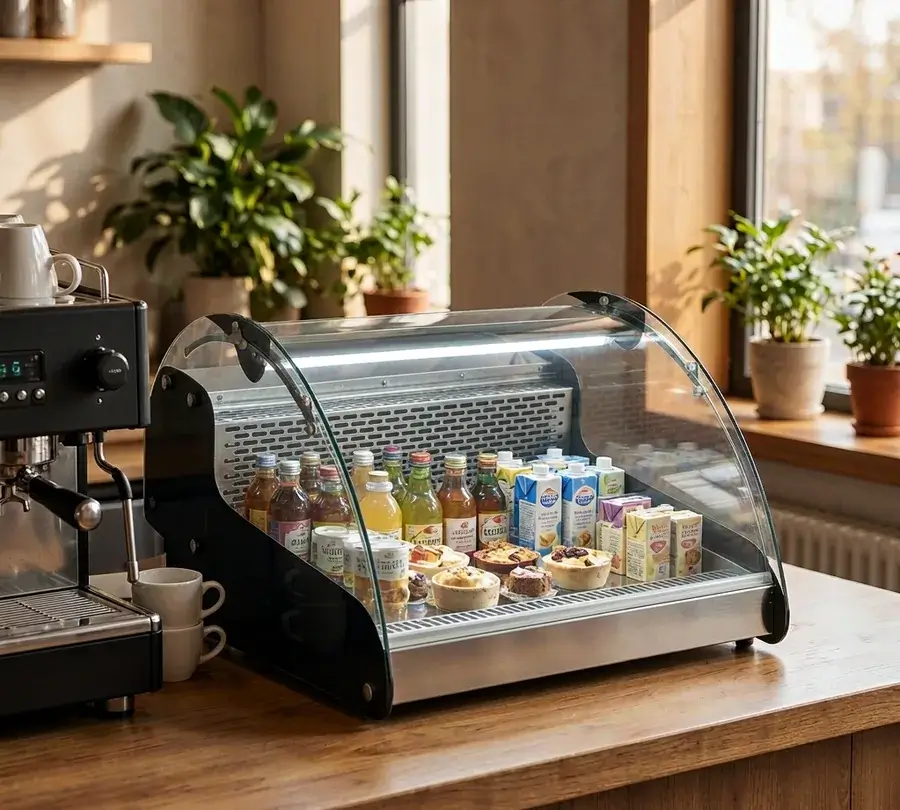
A countertop display fridge turns unused counter space into a working sales surface.
What Is a Countertop Display Fridge?
A countertop display fridge is a compact refrigerated merchandiser that sits on top of a counter or bar and uses glass panels to keep chilled products visible at the point of sale. Capacities typically range from about 100 to 200 liters, making it ideal for cakes, drinks, dairy and grab-and-go items in cafés, bakeries and convenience stores.
For bakery counters, the same format is usually sold as a countertop cake display fridge: four-sided glass, a curved front panel and a top section that opens for loading.
Unlike an upright showcase, it works with the flow of traffic: customers queue at the counter, notice the dessert case beside the register, and add an item without taking a step. That “last meter” impulse purchase is where the unit earns its keep.
Installation is simple, too: these units plug into a standard outlet, occupy no floor space, and with rated power between 110W and 400W across common models they add only a modest electrical load.
Countertop vs Under-Counter Display Fridge: The Core Difference
A countertop unit sells upward, displaying product in glass at hand level; an under-counter unit stores and dispenses downward, hiding stock behind sliding or hinged doors.
| Factor | Countertop display fridge | Under-counter display fridge |
|---|---|---|
| Primary job | Impulse selling and display | Storage and back-stock at the pass |
| Placement | On top of the counter | Below the worktop |
| Visibility | Full glass panels, 3–4 sided | Doors face staff, not customers |
| Counter space used | Yes — needs free counter area | No — frees up the counter |
| Typical products | Cakes, desserts, drinks, dairy | Bottled drinks, prep stock |
Many shops run both: an under-counter unit such as the 128L triple sliding-glass-door under-counter display fridge under the espresso station for restocking, plus a countertop case beside the register for display. If your counter is small and bare, start with countertop; if it is crowded with equipment, go under-counter.
Step 1 — Match Countertop Fridge Size to Your Counter
Measure Three Dimensions First
Before comparing models, measure three things at your counter:
- Width — the longest dimension of most units. Across the four models here it runs from about 880mm to 1,217mm, so measure your slot before assuming a compact case will fit.
- Depth — cases project toward the customer; leave enough passage behind the counter for staff.
- Height clearance — allow extra room above the unit for top-hinged or removable glass, plus any shelf, menu board or lighting.
Also check weight against what your counter can take: the 118L unit weighs 38.5kg net — light enough for most standard counters — while the 185L and 201L models reach 62kg and 84.5kg, where a reinforced or solid-base counter is the safer choice.
Four Smeta Models from 118L to 201L
Rather than fixed rules, think in capacity bands matched to your counter and product mix. The table below covers four published models — three countertop units plus one under-counter comparator (TDS-128WR(S)) for buyers weighing the two formats side by side:
| Model | Capacity | Temp range | Best for |
|---|---|---|---|
| TDS-118SR | 118L | 2–12°C | Café counters, drinks and small cake trays |
| TDS-128WR(S) | 128L | 0–12°C | Under-counter back-stock (comparator) |
| TDS-185WAR | 185L | 0–12°C | Bakery counters, full pastry lines |
| TDS-201WBR | 201L | 0–12°C | Dessert-led displays, mixed products |
The same four models, in importer terms:
| Model | Rated power | Refrigerant | Dimensions (mm, as published) | 40HQ loading |
|---|---|---|---|---|
| TDS-118SR | 110W | R134a/R600a | 695×882×417 | 140 pcs |
| TDS-128WR(S) | 253W | R134a/R600a | 910×510×575 | 168 pcs |
| TDS-185WAR | 278W | R134a/R600a | 1050×644×640 | 96 pcs |
| TDS-201WBR | 400W | R134a/R600a/R290 | 1217×590×685 | 81 pcs |
- 100–130L band — compact counters. The 118L curved-glass counter top display chiller is published at 695×882×417mm — the smallest footprint of the four — sized for a single counter section beside a register.
- 180–200L band — feature counters. The 201L countertop refrigerated cake display case spans 1,217mm and suits businesses where the chilled display is the centerpiece, not an add-on.
For importers, the 40HQ column matters too: 168 pieces of the 128L unit fit a container versus 81 of the 201L model — a direct change in landed cost per unit.
Step 2 — Choose the Right Glass for Your Display Fridge
Glass is the sales engine of a countertop fridge. Three decisions define it: shape, glazing, and how the case opens.
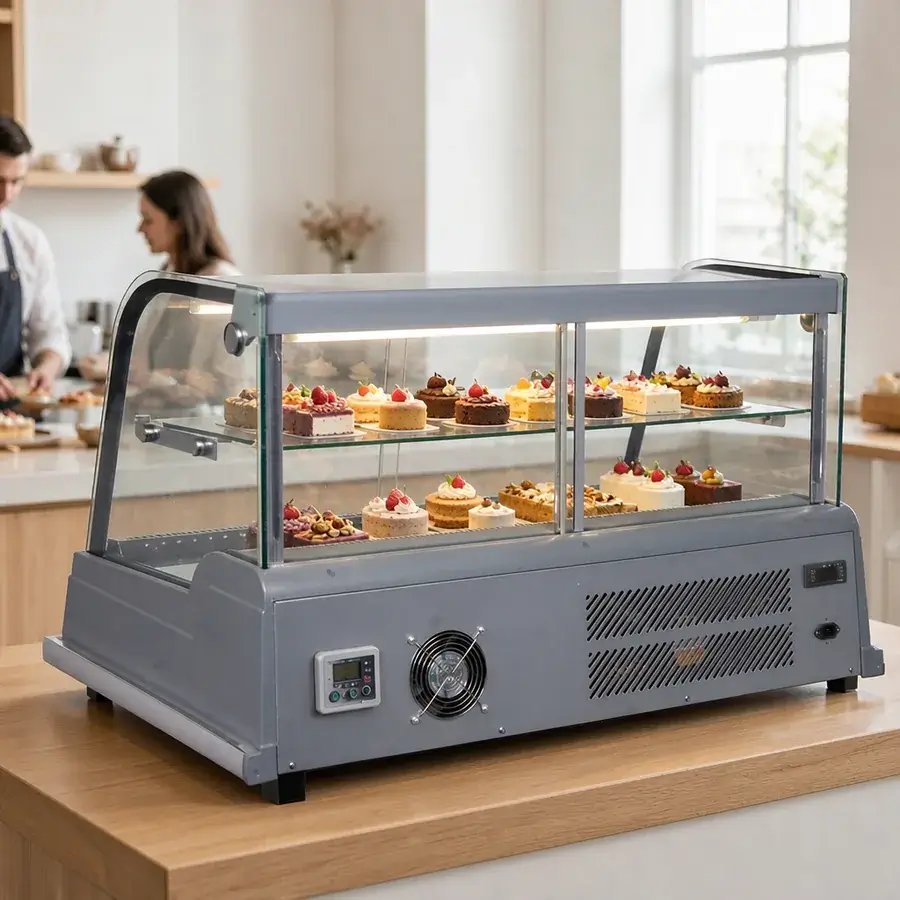
Curved front glass widens the viewing angle and makes premium pastry read larger.
Flat vs Curved Glass
Flat glass gives a clean silhouette and easy cleaning. Curved glass bends the front panel outward, widening the viewing angle so side-on customers still see products, and softening the unit’s visual bulk on a small counter.
Curved front glass works especially well for dessert and cake presentation, where a “jewel box” look helps sell premium items. The 185L countertop cake display cooler, for example, pairs four-sided glass with a curved front and a movable top panel.
Single vs Double Glazing and 4-Sided Glass
Glazing affects insulation, condensation and how much refrigeration work the unit must do:
- Single glazing — thinner, lighter, lower unit cost; sensible for milder indoor climates.
- Double glazing — an insulating air gap that limits heat gain and condensation, valuable in humid or hot locations.
- 4-sided glass — glass on the front, both sides and the top, for visibility from every direction of foot traffic.
The 201L model, for instance, pairs four-sided double glazing with shelves adjustable in two positions, so tall bottles and flat pastry trays both present well.
Doors That Match Your Workflow
- Movable top glass — fastest for staff serving from behind the counter; the 185L model’s top panel slides open for quick access.
- Sliding doors — need no swing clearance, ideal where staff space is tight — the signature layout of under-counter units like the 128L.
- Full curved corner glass — the 118L unit wraps the counter corner in curved glass, backed by auto defrost and digital temperature control.
Rule of thumb: the more staff serve through the case, the more the top opening matters; the more customers browse from the front, the more the front and side glass matter.
Step 3 — Temperature Range, Refrigerant and Climate Class
0–12°C or 2–12°C: Which Band Fits Your Products?
Most countertop models run either 0–12°C or 2–12°C, and that bottom number matters:
- 0–12°C — headroom for dairy, cream-topped desserts and chilled drinks that prefer colder holding.
- 2–12°C — suits cakes and pastries where you want chilled-but-not-too-cold texture without over-chilled icing.
Both cover the typical chilled dessert and beverage range; match the lower limit to your most temperature-sensitive product, not your average one.
A countertop display fridge turns unused counter space into a working sales surface.
R134a, R600a and R290
Refrigerant choice is now a procurement question: global warming potential (GWP, IPCC AR4 100-year values) varies enormously between common options:
| Refrigerant | GWP (IPCC AR4) | Available in |
|---|---|---|
| R134a | 1,430 | TDS-118SR / 128WR(S) / 185WAR / 201WBR |
| R600a | 3 | TDS-118SR / 128WR(S) / 185WAR / 201WBR |
| R290 | 3 | TDS-201WBR |
That is nearly a 500-fold difference. If your market has tightening refrigerant rules or sustainability procurement requirements, prioritize models offered with R600a or R290 — the 201L unit is available with all three. For distributors selling into the EU, this is no longer theoretical: Regulation (EU) 2024/573 phases down hydrofluorocarbons such as R134a, which steadily pushes new commercial refrigeration toward lower-GWP refrigerants.
Why Climate Class 4 Matters in Hot Markets
Climate class tells you the ambient conditions a fridge is rated to survive, not just function in. Climate Class 4, as defined in ISO 23953-2:2023, means the unit must hold its specified internal temperature in a 30°C environment at 55% relative humidity.
For buyers in the Middle East, southern Europe, Australia and the warmer parts of North America, this is not a datasheet footnote — it is the difference between a case that holds temperature through a 32°C afternoon and one that drifts upward with your cream cakes inside. All four models above are rated Climate Class 4, covering everything from an air-conditioned London café to an open-front bakery in Dubai.
Quick Selection Checklist by Business Type
Coffee shop. Counter space is tight and traffic is fast. The 118L curved-glass chiller fits a compact counter slot and presents cakes right beside the register; add an under-counter unit below if you need drink back-stock.
Bakery. Presentation is the product. A 180–200L four-sided glass case such as the 185L countertop cake display cooler offers a movable top glass for fast serving and a temp range that protects cream fillings.
Convenience store. Durability and versatility beat showcase styling: the 201L double-glazed case handles higher ambient loads and offers two shelf angle positions for mixed products.
Yogurt and dessert bar. Cups and toppings need cold holding that stays visible: a 0–12°C band with digital control keeps texture right, and curved glass tempts customers queuing at the bar.
FAQ
What size countertop display fridge do I need?
A small countertop display fridge in the 100–130L band needs roughly 880–910mm of counter width; 185–201L units need 1,050–1,217mm. Compact counters and single-register cafés suit the smaller band; dessert-led businesses usually step up to 180–200L.
What does Climate Class 4 mean on a display fridge?
It means the fridge must maintain its specified internal temperature in a 30°C environment at 55% relative humidity, as defined in ISO 23953-2. If your region regularly exceeds that, Climate Class 4 is the minimum specification you should accept.
Which refrigerant is best for a commercial countertop display refrigerator?
Low-GWP options such as R600a and R290 both score 3 on the IPCC AR4 scale, against 1,430 for R134a — a clear advantage in markets with refrigerant regulations or sustainability procurement requirements. Check availability per model: the 201L unit is offered with all three.
How many countertop display fridges fit in a 40HQ container?
It depends on the model: 140 pieces per 40HQ for the 118L unit, 168 for the 128L, 96 for the 185L and 81 for the 201L. If you are planning an import program, factor loading density into landed cost alongside unit price.
Conclusion
Choosing a countertop display fridge comes down to three decisions you can now make in five minutes:
- Size — measure counter width, depth and height clearance, then pick a capacity band: 118–128L for compact counters, 185–201L for feature counters.
- Glass — curved glass for wider viewing angles and premium dessert presentation; double glazing for hot or humid locations; a top opening that matches how your staff serve.
- Temperature and climate — 0–12°C or 2–12°C matched to your most sensitive product, Climate Class 4 for hot markets, and low-GWP refrigerants like R600a or R290 where regulations and buyers reward them.
If one model keeps matching your answers, it is the 185L countertop cake display cooler — curved front glass, four-sided visibility, a movable top panel and Climate Class 4 in a 1,050mm footprint. If a countertop unit will not fit your counter at all, compare upright and under-counter formats in the full display fridge range before settling on a compromise size. For importers planning a container, get in touch with Smeta about branding, voltage and glass format before committing space. Smeta has built commercial refrigeration for 20+ years across production bases in China and Thailand, with OEM/CKD support and buyers in more than 100 countries.
Sources
- Grand View Research — Refrigerated Display Cases Market Report (market size 2025 and 2033, 7.6% CAGR 2026–2033)
- Fortune Business Insights — Bakery Products Market (2026 market size, Europe share)
- ISO 23953-2:2023 — Refrigerated display cabinets, classification and requirements (Climate Class definitions)
- IPCC AR4 — Direct Global Warming Potentials (GWP values for R134a, R600a, R290)
- Smeta product pages — TDS-118SR / TDS-128WR(S) / TDS-185WAR / TDS-201WBR specification tables


